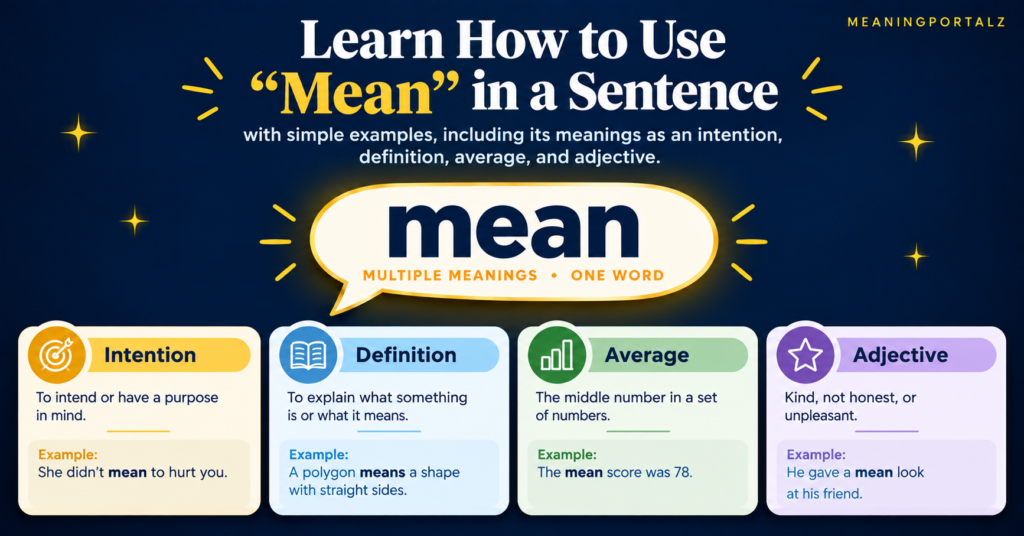
The word mean has several common meanings in English. It can describe an intention, explain what a word or statement signifies, refer to an average in mathematics, or describe someone as unkind. Learning how mean changes according to context makes it easier to use correctly in everyday speaking and writing. For more insight read hare mean’t or meant
Thank you for reading this post, don't forget to subscribe!Mean in a Sentence: Meanings What Does “Mean” Mean?
Mean is a versatile English word with several meanings. Its meaning depends on how it is used in a sentence.
The most common uses are:
- To intend something
- To signify or indicate something
- To refer to an average
- To describe someone as unkind or unpleasant
- To be likely or destined to do something
Here are simple examples:
- “What do you mean?”
- “I mean to call you tomorrow.”
- “What does this word mean?”
- “The mean of 5, 10, and 15 is 10.”
- “That was a mean thing to say.”
Although these sentences all use the same word, mean has a different meaning in each one.
Mean in a Sentence: Meanings Parts of Speech of “Mean”
The word mean can function as different parts of speech depending on the sentence. It is most commonly used as a verb, adjective, or noun.
Mean as a Verb
As a verb, mean can express intention or indicate what something signifies.
- “I mean to call you tomorrow.” — mean means intend.
- “What does this word mean?” — mean asks about its definition or significance.
- “I didn’t mean to upset you.” — mean refers to intention.
Mean in a Sentence: Meanings Mean as an Adjective
As an adjective, mean can describe someone or something as unkind, cruel, unpleasant, or nasty.
- “That was a mean comment.”
- “Don’t be mean to your sister.”
- “He was mean to the new student.”
In mathematics, mean can also function as an adjective in terms such as arithmetic mean, although the word is commonly treated as a noun when referring to the calculated average.
Mean in a Sentence Mean as a Noun
As a noun, mean refers to the average of a set of numbers in mathematics and statistics.
- “The mean of 5, 10, and 15 is 10.”
- “Calculate the mean of these test scores.”
- “The class had a mean score of 78.”
So, the grammatical role of mean depends on the context in which it appears.
Mean in a Sentence: Meanings “Mean” as Intention
One of the most common uses of mean is to express what someone intends to do or intends to communicate.
For example:
“I mean to finish my homework tonight.”
Here, mean means intend.
More examples include:
- “I didn’t mean to hurt your feelings.”
- “She means to study harder this year.”
- “Did you mean to send this message to me?”
- “We mean to visit them next weekend.”
- “He didn’t mean any harm.”
A particularly common expression is “I mean…”, which people use when clarifying, correcting, or explaining what they are trying to say.
“I mean, we could leave earlier if you want.”
Mean in a Sentence: Meanings “Mean” as Definition or Significance
Mean can also ask or explain what something represents, signifies, or defines.
For example:
“What does this sentence mean?”
Here, mean asks for the definition or intended message.
Other examples:
- “What does this word mean?”
- “What does this symbol mean?”
- “This sign means that the road is closed.”
- “Her smile meant that she was happy.”
- “What did he mean by that?”
This use is especially common when learning vocabulary. If someone asks “What does this word mean?”, they are asking for its definition or explanation.
Mean in a Sentence: Meanings “Mean” in Mathematics
In mathematics and statistics, mean has a specific meaning: it usually refers to the arithmetic average.
To find the mean, add all the numbers together and divide the total by the number of values.
For example, if the numbers are 5, 10, and 15:
5 + 10 + 15 = 30
30 ÷ 3 = 10
Therefore, the mean is 10.
Example sentences:
- “The mean score was 82.”
- “Find the mean of these five numbers.”
- “The average and arithmetic mean are the same in this example.”
- “The mean temperature for the week was 25°C.”
In everyday English, average is often used instead of mean, but in mathematics, “mean” is a standard statistical term.
“Mean” as an Adjective for Someone Unkind
Mean can also be an adjective describing someone who is unkind, cruel, or unpleasant.
For example:
“That was a mean thing to say.”
Here, mean means unkind.
Other examples:
- “He was mean to his younger brother.”
- “Don’t be mean to her.”
- “That was a really mean joke.”
- “She apologized for being mean.”
- “Why are you being so mean?”
This use is common in everyday conversations, particularly when talking about someone’s behavior.
However, mean can have different strengths depending on context. Calling someone “mean” may describe anything from mildly rude behavior to deliberately cruel treatment.
Mean in a Sentence: Meanings “Mean” in Everyday Conversations
The word appears frequently in spoken English and informal conversations.
For example:
Person A: “Are you coming with us?”
Person B: “I didn’t say no. I mean, I’ll probably come.”
Here, I mean is being used to clarify or adjust what the speaker is saying.
Another common expression is:
“What do you mean?”
This can simply ask for clarification, but depending on tone, it can also sound surprised, confused, or even annoyed.
For example:
A: “You shouldn’t go there.”
B: “What do you mean?”
The second speaker is asking the first person to explain their statement.
Mean in a Sentence: Meanings Simple Sentences Using “Mean”
Here are examples covering the major meanings:
| Meaning | Part of Speech | Example |
|---|---|---|
| Intend | Verb | “I didn’t mean to upset you.” |
| Definition | Verb | “What does this word mean?” |
| Signify | Verb | “Red usually means stop.” |
| Mathematical average | Noun | “The mean of 4, 6, and 8 is 6.” |
| Unkind | Adjective | “That was a mean comment.” |
| Clarification | Verb | “I mean, we can try again.” |
Mean in a Sentence: Meanings Related Words
Several words are closely connected to the different meanings of mean.
When mean means intend, related words include intend, plan, and aim.
When it means signify, related words include indicate, represent, and signify.
When it means unkind, related words include cruel, rude, and unkind.
The correct related word depends on which meaning of mean is being used.
Mean in a Sentence: Meanings FAQ
How do you use “mean” in a sentence?
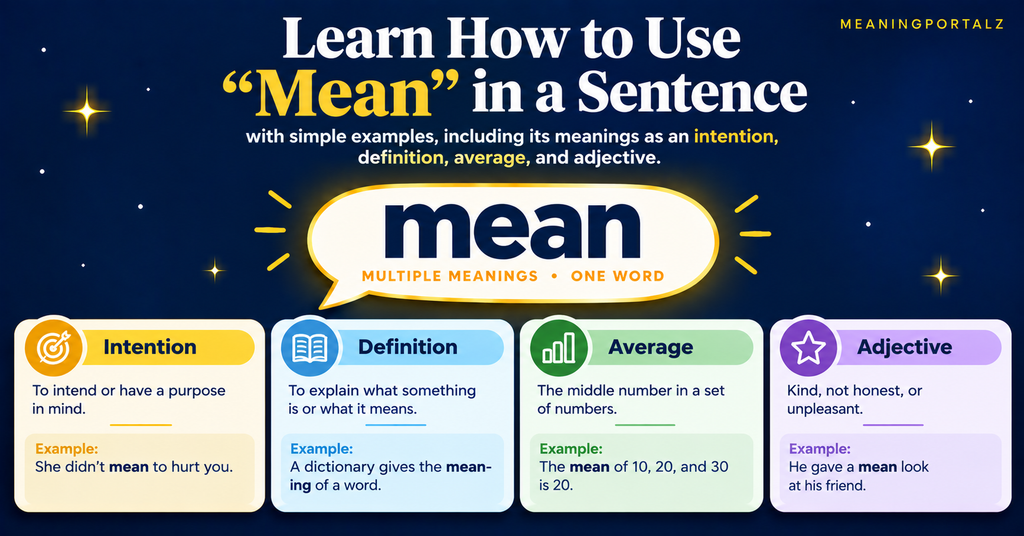
You can use mean to express intention, definition, significance, mathematical average, or unkind behavior. For example, “I didn’t mean to hurt you” uses it to express intention.
What does “mean” mean in a sentence?
The meaning of mean depends on context. It can mean “intend,” “signify,” “average,” or “unkind.”
What is an example of “mean” as an average?
“The mean of 10, 20, and 30 is 20” is an example of mean referring to a mathematical average.
What is an example of “mean” as an adjective?
“That was a mean thing to say” uses mean as an adjective meaning unkind or hurtful.
Is “mean” a verb or an adjective?
Mean can be both. It is a verb in “I mean what I say” and an adjective in “He is mean to his brother.” It can also be a noun when it refers to a mathematical average.
Conclusion
The word mean is a versatile English word that can work as a verb, adjective, or noun, depending on the context. It can express intention, explain the meaning of something, describe unkind behavior, or refer to a mathematical average. Understanding these different uses makes it easier to use mean correctly and naturally in everyday English.